

Asian Rhinoplasty vs. Traditional Rhinoplasty: Why Specialist Expertise Matters for Your Results
When considering rhinoplasty, understanding the distinction between Asian rhinoplasty and traditional rhinoplasty and why specialized expertise matters is essential to achieving a result that looks natural, balanced, and uniquely yours. At Shine Cosmetic Surgery, Dr. Daniel H. Lin, D.O., and his team tailor rhinoplasty procedures to your individual anatomy and aesthetic goals, with a special focus on ethnic nuance and harmony.For more information, contact us or request an appointment online. We are conveniently located at 2707 E Valley Blvd Suite 115, West Covina, CA 91792.
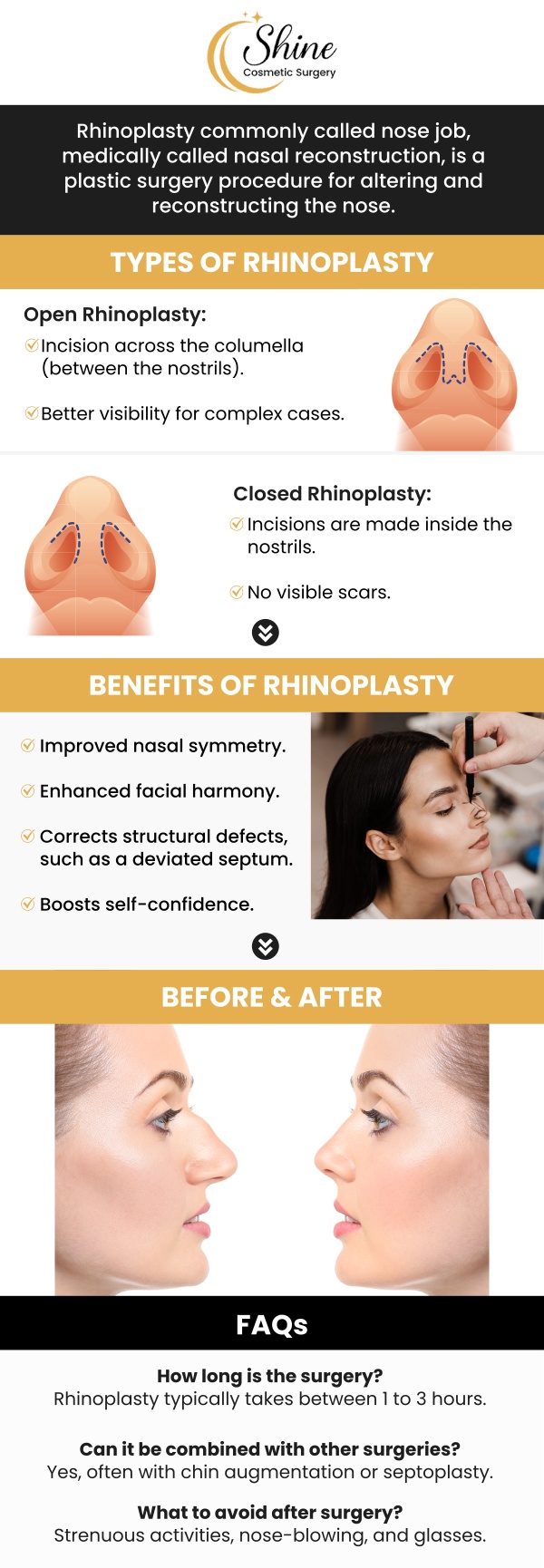
Table of Contents:
What is the difference between Asian rhinoplasty and traditional rhinoplasty?
Why is specialist expertise important for rhinoplasty procedures?
How do facial features influence the approach to rhinoplasty?
What are common goals for patients seeking Asian rhinoplasty?
How does Shine Cosmetic Surgery ensure my Asian rhinoplasty looks balanced and harmonious with my face?
The primary difference between Asian rhinoplasty and traditional rhinoplasty lies in both anatomical considerations and aesthetic goals.
In conventional or “traditional” rhinoplasty — often developed around Caucasian nasal anatomy — surgical goals frequently include reducing features such as a dorsal hump (bridge prominence), narrowing overly wide nasal bones, and refining a thin or upturned tip. Techniques often involve reshaping or removing cartilage and bone to achieve a slimmer profile.
By contrast, Asian rhinoplasty typically focuses on augmentation and structural enhancement rather than reduction. Many Asian patients naturally have:
● A lower nasal bridge
● Thicker skin
● Softer or less developed cartilage
● A tip that appears flatter or less projected
These features influence surgical planning because traditional reduction techniques may not create the desired result. Instead of removing structure, Asian rhinoplasty often involves building up areas to enhance definition and projection, especially at the bridge and tip. Cartilage grafts — often from the patient’s septum, ear, or rib — or carefully selected implants may be used to provide support and subtle yet natural elevation.
This specialized approach ensures that enhancements blend with, rather than override, your natural features and cultural identity.
Rhinoplasty is one of the most technically demanding types of cosmetic plastic surgery. Even minute changes in the nose’s structure can significantly alter facial harmony — particularly because the nose occupies the central aesthetic position on the face.
Here’s why specialist expertise matters:
● Precision in anatomical assessment
A surgeon experienced in diverse nasal anatomies can recognize the subtleties of different ethnic features. Asian noses often have thicker skin and weaker cartilage, which can mask structural changes or require strategic support to achieve desired results. Understanding these nuances prevents over-reduction or unnatural outcomes.
● Tailored structural techniques
Traditional rhinoplasty techniques were largely developed for thinner skin and stronger nasal frameworks. Applying the same methods to ethnic rhinoplasty without adjustment can lead to disappointing results — such as a nose that looks too slender, too “Western,” or out of proportion with the rest of the face. Experienced specialists use augmentation techniques, advanced grafting, and proportion-based planning to achieve balanced outcomes.
● Cultural and aesthetic sensitivity
Aesthetic beauty isn’t universal — it’s deeply tied to cultural, personal, and facial context. What looks harmonious on one face may not translate on another. Surgeons with specialist training respect these differences and work with your individual facial proportions and goals, rather than forcing one fixed aesthetic ideal.
● Functional preservation
Rhinoplasty isn’t only cosmetic. The internal nasal structure supports airflow and breathing. A highly skilled surgeon ensures that aesthetic improvements do not compromise — and may even enhance — nasal function.
For these reasons, choosing a surgeon like Dr. Daniel Lin at Shine Cosmetic Surgery, who has experience with ethnic rhinoplasty and individualized treatment, increases the likelihood of results that are both beautiful and natural.
Facial features — including proportions, bone structure, and soft tissue characteristics — play a crucial role in planning a successful rhinoplasty. In ethnic rhinoplasty, rather than applying a one-size-fits-all template, surgeons assess multiple dimensions:
● Nasal bridge height and projection
A lower nasal bridge may be elevated or augmented to create smoother profile lines and enhance midfacial balance without creating an overly prominent or artificial look.
● Tip definition and support
If the nasal tip is flatter or less defined, structural support may be added through cartilage grafting rather than sculpting — ensuring the tip refines naturally under thicker skin.
● Nostril shape and width
Wide nostrils or alar flaring may be addressed through alar base reduction or refined shaping to create symmetrical, proportionate contours.
● Facial harmony
Aesthetic planning always considers the nose in relation to cheekbones, chin projection, and overall facial balance. A nose that is technically “perfect” in isolation may still look unbalanced if it doesn’t harmonize with other features.
At Shine Cosmetic Surgery, careful facial analysis ensures that changes to the nose enhance your overall appearance and maintain ethnic identity.
Patients seeking Asian rhinoplasty often want outcomes that are refined yet natural, preserving their ethnic features while improving specific characteristics. Some common goals include:
● Enhancing nasal bridge definition to create stronger profile lines without appearing artificial.
● Refining the nasal tip to improve shape and projection.
● Adjusting nostril width or flare for balanced symmetry.
● Preserving overall facial harmony rather than pursuing dramatic reshaping.
● Improving breathing or correcting structural issues along with cosmetic goals.
Importantly, many Asian rhinoplasty patients seek subtle, proportionate enhancements rather than dramatic transformations. By aligning surgical tactics with personal desires and facial anatomy, the best results look effortless and natural.
At Shine Cosmetic Surgery, achieving a harmonious and individualized result starts with your initial consultation. Dr. Daniel H. Lin, D.O., evaluates your facial structure, nasal anatomy, skin thickness, and aesthetic goals to develop a customized surgical plan.
Key ways Shine Cosmetic Surgery ensures balanced results include:
● Comprehensive facial analysis
Rather than focusing on the nose in isolation, the team analyzes how the nose relates to your cheeks, chin, and overall profile to create facial harmony.
● Customized surgical plan
Based on your discussions, Dr. Lin chooses the appropriate combination of augmentation, cartilage grafting, tip refinement, or nostril reshaping to suit your goals and anatomy.
● Cultural and aesthetic sensitivity
Shine Cosmetic Surgery emphasizes results that enhance your natural beauty while respecting your ethnic identity — not transforming it into an unrelated aesthetic.
● Functional consideration
Assessment isn’t only cosmetic — breathing function and internal nasal structure are evaluated and preserved or improved as part of your surgery plan if needed.
● Clear communication and planning
In your consultation and preoperative planning, you and your surgeon will set realistic expectations, review surgical goals, and address any questions about the procedure and recovery. For more information, contact us or request an appointment online. We are conveniently located at 2707 E Valley Blvd Suite 115, West Covina, CA 91792. We serve patients from West Covina CA, San Gabriel Valley CA, Rowland heights CA, Walnut CA, Rosemead CA, and surrounding areas.
Check Out Our 5 Star Reviews



 Send Text
 How May I Help You?